
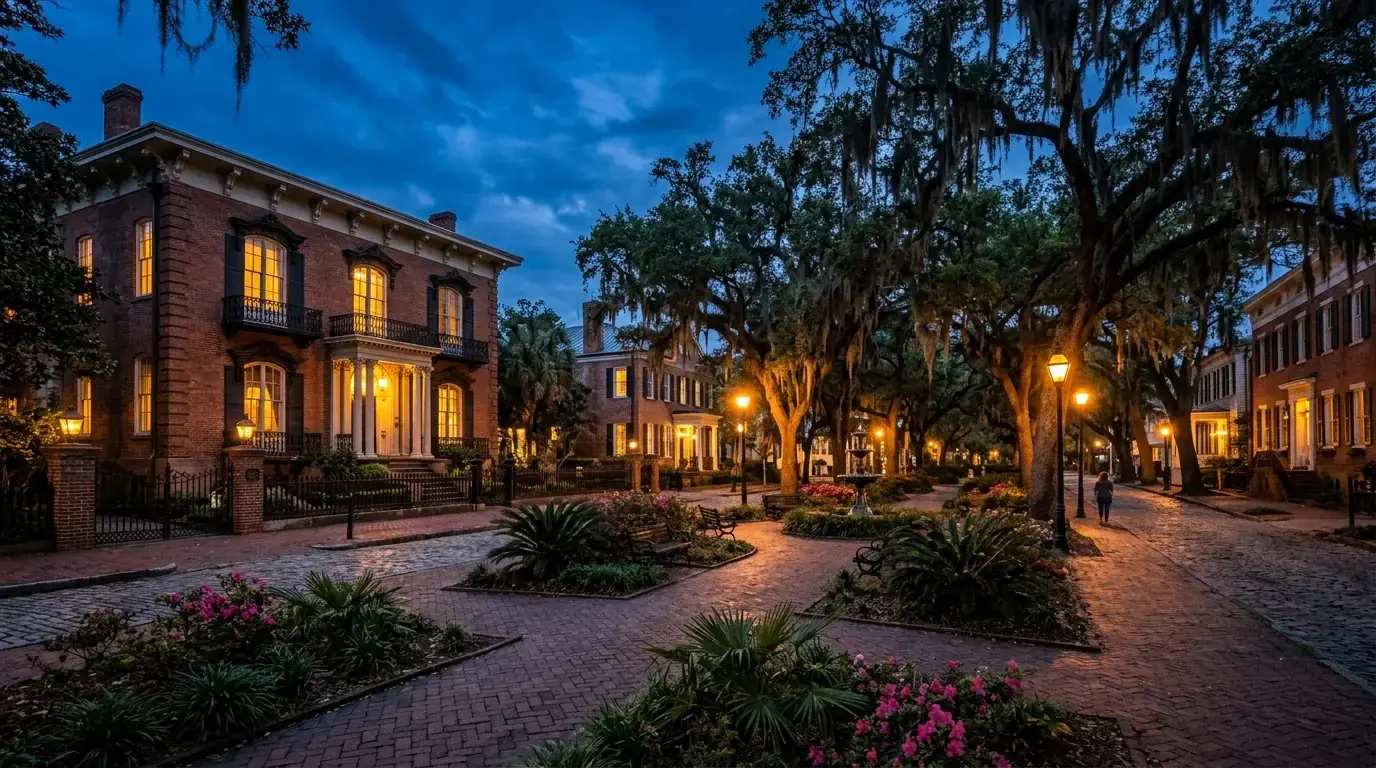
Savannah is considered haunted because an unusually large amount of difficult history remains physically visible in a compact, walkable city. Epidemics killed hundreds at a time, soldiers fought and died here, historic burial grounds sit within today's cityscape, and generations of residents lived and died inside buildings that still stand.
That history does not prove Savannah has ghosts. It does explain why stories of apparitions, footsteps, voices, and restless spirits became so closely attached to its hotels, houses, cemeteries, squares, and streets.
Quick Takeaways
- Savannah was founded in 1733 and retains an unusually intact historic core.
- Severe yellow fever epidemics killed hundreds of Savannah residents, including more than 1,000 during the 1854 outbreak.
- British occupation and the 1779 Siege of Savannah gave the city substantial Revolutionary War history.
- Savannah's history includes slavery, the transatlantic slave trade, and burial grounds used by enslaved and free Black residents.
- Colonial Park Cemetery contains more than 9,000 graves in the center of the Historic District.
- A 2026 ground-penetrating radar survey found more than 80 potential burial anomalies at Whitefield Square.
- Historic preservation keeps old buildings and landscapes physically connected to the stories told about them.
- "America's Most Haunted City" is a popular tourism label, not an objectively proven title.
Savannah Has More Than 290 Years of Recorded History
Savannah was established in 1733 when James Oglethorpe and the first Georgia colonists laid out the settlement along the Savannah River.
The city's distinctive plan organized streets around public squares. Twenty-two of Savannah's historic squares survive today, along with a large collection of buildings constructed across the 18th, 19th, and early 20th centuries.
That physical survival matters to haunted folklore.
Ghost stories are easier to attach to a staircase, bedroom, cemetery wall, old hospital, or specific square than to a location where every physical trace of the past has disappeared. In Savannah, travelers can often stand inside or beside the actual places around which stories developed.
The National Park Service designated the Savannah Historic District a National Historic Landmark in 1966. Its significance includes both the surviving town plan and its extensive collection of historic architecture.
Savannah therefore feels unusually close to its past before anyone tells a ghost story.
Yellow Fever Gave Savannah a Real History of Mass Death
Disease is one of the most important historical reasons Savannah became associated with death.
Savannah's coastal climate created favorable conditions for mosquito-borne diseases before people understood how yellow fever spread. The city experienced repeated epidemics during the 18th and 19th centuries.
Two years were particularly devastating.
In 1820, more than 700 people died during a severe yellow fever epidemic. The same year, a major fire destroyed a large portion of Savannah.
Another severe outbreak struck in 1854. Slightly more than 1,000 people died from yellow fever that year.
For a city with a much smaller population than modern Savannah, losses on that scale affected households throughout the community.
Some modern haunted-hotel stories are linked to this history. The Marshall House, for example, records that the building was used as a hospital during mid-19th-century yellow fever epidemics.
The documented history establishes disease, hospitals, and large numbers of deaths.
What it does not establish is that a particular modern sound, apparition, or unexplained event can be identified as a specific yellow fever victim.
That second step belongs to paranormal interpretation.
War Repeatedly Reached Savannah
Savannah's military history provides another major source for local ghost stories.
British forces captured Savannah in December 1778 during the American Revolution. French and American forces attempted to retake the city during the Siege of Savannah in 1779 but failed.
The fighting created a genuine battlefield landscape around the city.
Savannah later faced another military occupation during the Civil War. Union forces entered the city in December 1864 near the end of William T. Sherman's March to the Sea.
Historic buildings were repurposed during that period.
The Marshall House records that Union troops occupied the hotel in 1864 and 1865 and used it as a hospital.
Modern reports of soldier-like apparitions at historic properties are often connected to these events. The historical events themselves are documentable.
The supernatural connection remains an interpretation.
Savannah Really Does Have Historic Burial Grounds Beneath Parts of the Modern City
One of Savannah's most repeated ghost-tour claims is that the city was "built on the dead."
That statement is too broad to use as literal history.
There is, however, strong evidence that specific parts of modern Savannah overlap historic burial grounds.
Colonial Park Cemetery
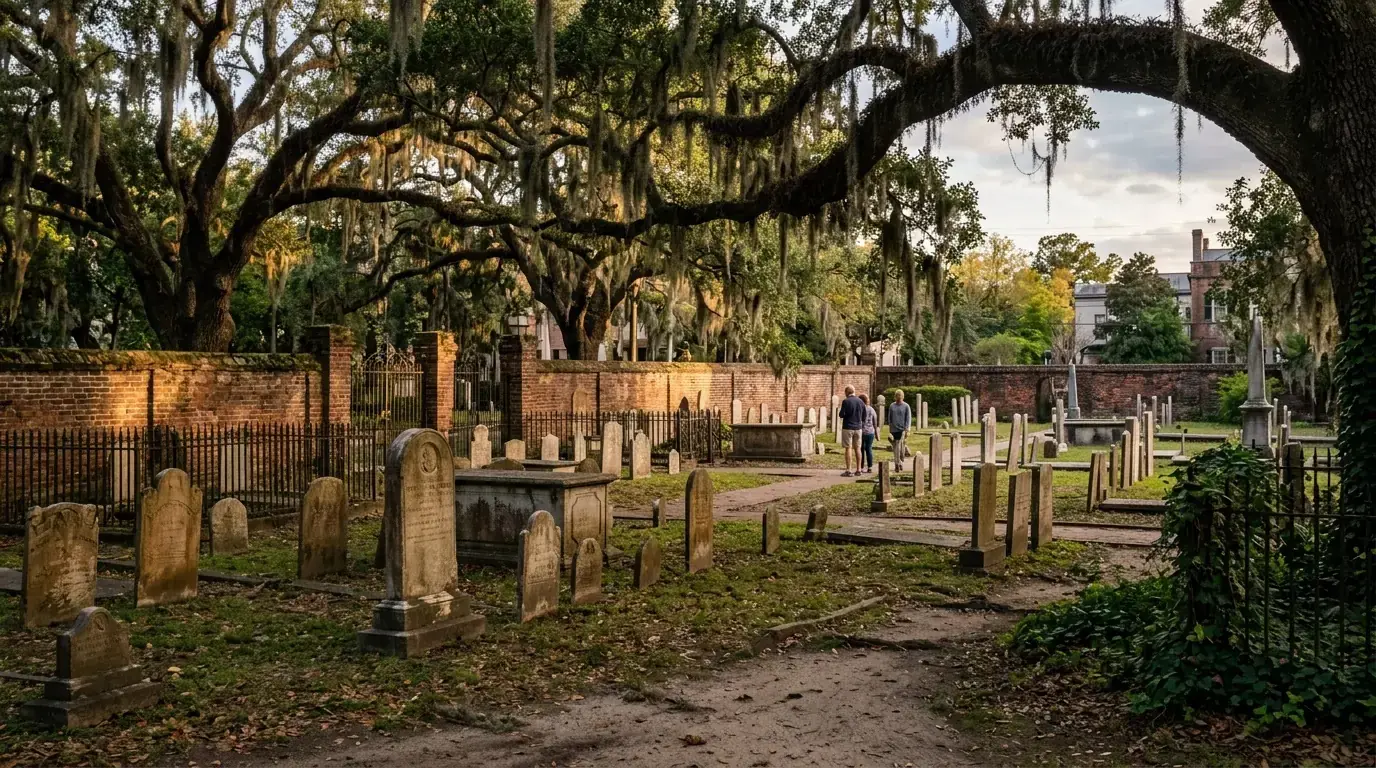
Colonial Park Cemetery was established in 1750 and served as Savannah's primary public cemetery until 1853.
The approximately six-acre cemetery contains more than 9,000 graves.
Today it sits directly within the Historic District, surrounded by streets, houses, churches, businesses, and tourist activity.
Its long burial history and central location make it one of Savannah's most prominent ghost-tour settings.
Whitefield Square
Whitefield Square provides an even more important example because the evidence has recently become clearer.
Historical records show that a burial ground used by Savannah's enslaved and free people of color operated in this area from approximately 1763 until 1844. Part of the burial ground overlapped what is now Whitefield Square.
The City of Savannah commissioned a ground-penetrating radar survey in December 2025.
Results announced in February 2026 identified more than 80 potential burial anomalies within the square and two probable burial clusters. The city said many of those anomalies are likely intact burials or burial shafts from which remains may previously have been removed.
The finding does not prove paranormal claims about Whitefield Square.
It does demonstrate why blanket dismissal of every Savannah burial-ground story would be just as careless as automatically believing all of them.
The right question is always: what does the historical and archaeological evidence show at this specific location?
Slavery Is Part of Savannah's History, Not Haunted-House Decoration
Savannah's development cannot be explained honestly without slavery.
Plantation agriculture based on rice and cotton generated enormous wealth around the city. Savannah's port also participated in the transatlantic slave trade.
Thousands of enslaved African Americans lived and worked in Savannah and the surrounding Lowcountry.
That history also shaped the city's burial landscape.
The burial ground associated with modern Whitefield Square was used by both enslaved and free people of color. Later, Laurel Grove South became one of Savannah's most important African American cemeteries.
These sites deserve historical treatment before paranormal interpretation.
Slavery should never be reduced to a convenient explanation for why somewhere is supposedly haunted. The people involved had lives, families, communities, religious traditions, businesses, and histories that matter independently of ghost tourism.
Where paranormal traditions intersect with those places, the historical record should remain the starting point.
Fires Added Another Layer of Destruction
Savannah also endured major urban fires.
Two of the most destructive occurred in 1796 and 1820. Historical accounts describe each as leaving roughly half of the city in ruins.
The 1820 fire was particularly devastating because it occurred during the same year as a severe yellow fever epidemic.
Fire stories later became part of Savannah's broader haunted folklore, especially where older buildings were destroyed, reconstructed, altered, or incorporated into newer structures.
As with epidemics and warfare, a fire can be historically documented without proving that later paranormal reports were caused by its victims.
The event and the ghost story remain separate categories.
Historic Preservation Keeps Savannah's Past Visible
Savannah might have developed a very different paranormal identity if most of its historic buildings had disappeared.
Instead, preservation became one of the defining features of the city.
The Historic District retains the original town-plan structure along with more than a thousand historic residential and public buildings. Travelers can walk between houses, squares, cemeteries, churches, hotels, and commercial buildings representing several centuries of development.
That gives Savannah ghost stories something unusually powerful: physical continuity.
A traveler can hear a story about a 19th-century hotel and then sleep there.
They can hear about an old burial ground and walk through the same square.
They can hear about a family that occupied a mansion and then stand inside rooms from that period.
Whether someone believes in ghosts or not, the places themselves are often real.
Savannah's Architecture Helps Create the Haunted Atmosphere
There is also a simpler explanation for Savannah's reputation.
The city looks the part.
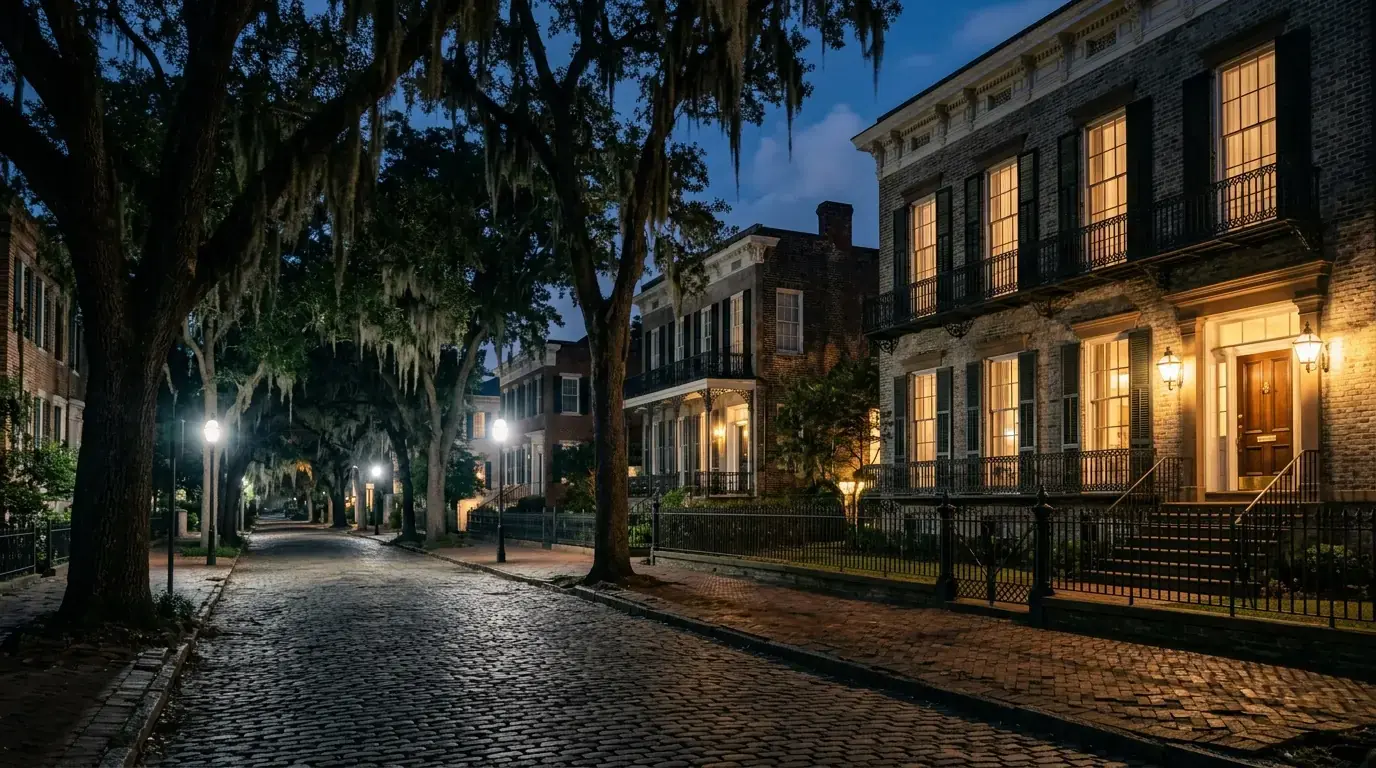
Historic mansions face shaded squares. Live oak branches stretch across streets beneath curtains of Spanish moss. Brick sidewalks run past cemeteries, iron fences, narrow lanes, old churches, and houses illuminated by porch lamps.
After dark, that environment becomes an exceptionally effective setting for storytelling.
Old buildings also make ordinary noises.
Wood expands and contracts. Floors creak. Pipes knock. Air moves through older windows and chimneys. Guests hear people in hallways, neighboring rooms, streets, and courtyards.
None of that explains every experience someone reports.
It does mean that an unexplained noise inside a 150-year-old building is not automatically evidence of paranormal activity.
Ghost Tours Helped Turn Haunted Savannah Into a Travel Identity
History alone does not explain why Savannah is now so strongly identified with ghosts.
Storytelling does.
Savannah has developed a large ghost-tour industry that includes walking tours, trolley tours, paranormal investigations, pub crawls, cemetery tours, and experiences involving access to historic properties.
Tours repeat older legends while also introducing new generations of visitors to local stories.
Hotels participate too.
The Marshall House acknowledges its haunted reputation. Kehoe House publishes its own haunted-history material. 17Hundred90 identifies Room 204 as its most haunted guest room.
This creates a reinforcing cycle.
Travelers arrive expecting a haunted city. They take ghost tours, stay in reputedly haunted hotels, share unusual experiences, post stories online, and introduce the folklore to another audience.
Over time, paranormal tourism itself becomes part of Savannah's cultural history.
Is Savannah Really America's Most Haunted City?
Savannah is frequently called "America's Most Haunted City," including in its own tourism marketing.
There is no recognized scientific or historical system for ranking cities by how haunted they are.
No reliable metric can tell us that Savannah has more ghosts than New Orleans, Charleston, St. Augustine, Gettysburg, or any other historic destination.
The phrase is better understood as a reputation.
Savannah has an unusually strong claim to that reputation because several ingredients come together in one place:
- Centuries of documented history
- Epidemics and mass mortality
- Revolutionary and Civil War history
- Historic cemeteries and burial grounds
- A deeply preserved architectural landscape
- Numerous historic hotels and houses still open to visitors
- A mature ghost-tour industry
- Generations of local folklore and guest reports
That combination is much easier to demonstrate than any claim that Savannah literally contains more ghosts than another city.
Which Savannah Haunted Stories Are Actually True?
The answer depends on what "true" means.
Many historical events behind Savannah's ghost stories are completely real.
Yellow fever epidemics happened. Soldiers fought here. Historic homes still stand. Colonial Park Cemetery contains thousands of graves. The Marshall House served as a hospital. A burial ground used by enslaved and free Black residents overlapped what is now Whitefield Square.
Paranormal interpretations are different.
A guest may genuinely report hearing unexplained footsteps. A tour guide may accurately tell you that generations of people have repeated a particular apparition story.
Neither proves that a ghost caused the experience.
Some legends have even accumulated fictional details over time.
The famous Kehoe House story claiming that two children died inside the mansion is a good example. The story is widely repeated, but the alleged deaths are not supported by reliable historical evidence.
Savannah becomes more interesting, not less, when those distinctions stay visible.
Why Savannah Feels Haunted Even If You Are a Skeptic
You do not need to believe in ghosts to understand Savannah's haunted reputation.
Walk through the Historic District at night and much of the explanation becomes obvious.
The past is unusually tangible here.
You encounter old houses rather than plaques marking where old houses once stood. Cemeteries remain inside the modern city. Original squares still organize the streets. Hotels operate in buildings that witnessed epidemics, war, family deaths, prosperity, decline, and restoration.
Then Savannah adds centuries of storytelling on top of that physical landscape.
For a believer, that can feel like a city where the past never completely left.
For a skeptic, it can feel like one of America's best environments for historical folklore.
Either way, the history is the part worth understanding first.